
Are ai chat Conversations More Fun Than Traditional Chatbots?
Many people find AI chat conversations more enjoyable than traditional chatbots because they continue discussions, remember earlier messages within a session, and respond in natural language instead of fixed scripts. Industry reports published between 2023 and 2025 show that large language model adoption grew rapidly, with hundreds of millions of users trying AI assistants for writing, learning, coding, and entertainment. Traditional chatbots still complete routine customer support efficiently, but AI conversations usually last longer because users can change topics freely without restarting the interaction.
AI chat has changed how people expect online conversations to work. A customer support bot from 2018 usually recognized keywords and matched them to a prepared reply. By 2025, many AI systems could generate original responses, explain complicated ideas in simple language, and continue discussions across dozens of messages. Users no longer needed to select buttons or repeat the same question several times before getting useful information.
That improvement also changed how long people stayed in conversations. Research from software analytics companies has shown that people often exchange dozens of messages during a single AI session instead of ending the conversation after one answer. A person might begin with travel planning, continue with restaurant suggestions, and later ask for help writing an email, all without opening another application.
Traditional chatbots usually answer one request at a time. AI chat systems can switch topics naturally while keeping earlier context in the same conversation, making the experience feel closer to talking with another person than navigating a menu.
The difference becomes easier to understand when comparing common features.
| Feature | Traditional Chatbot | AI Chat |
|---|---|---|
| Response method | Scripted replies | Generated responses |
| Context | Limited | Multi-turn conversation |
| Topics | Usually one business area | Broad general knowledge |
| Creativity | Low | High |
| Writing help | Limited | Emails, stories, summaries, code |
| Personalization | Basic | Adapts to user style during a session |
Because conversations feel less restricted, people also use AI for hobbies instead of only solving problems. Language learners practice speaking, students ask for different explanations of the same lesson, writers brainstorm ideas, and programmers review code. A 2024 survey from several workplace software providers found that many employees were already using generative AI every week for drafting documents, editing text, or organizing information instead of relying only on search engines.
Entertainment has become another reason users spend more time chatting with AI. Instead of ending after a question is answered, conversations can continue into storytelling, trivia games, historical role-play, or fictional worlds. Since responses are generated in real time, the same prompt rarely produces identical conversations twice, giving people a reason to return.
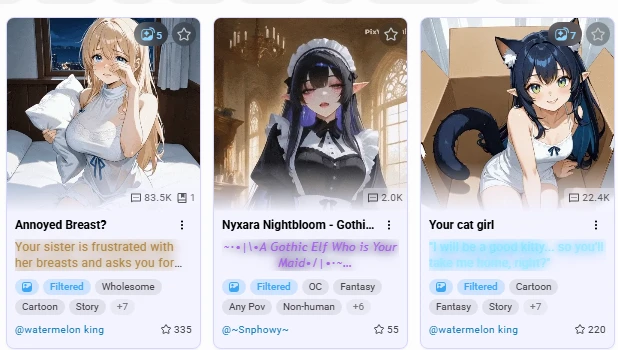
Some users also explore specialized communities discussing nsfw ai applications, interactive role-play, and character-based conversations. These discussions reflect how conversational AI has expanded beyond customer service into creative writing, gaming, and entertainment. Individual platforms apply different moderation rules, privacy policies, and age requirements, so user experiences vary depending on the service.
The quality of modern conversations also comes from language understanding. Large language models are trained on diverse public text and learn relationships between words rather than memorizing complete conversations. When someone asks a follow-up question such as "Can you explain that in simpler words?" the system usually understands that "that" refers to the previous explanation instead of asking the user to repeat everything again.
Another difference appears when discussing unfamiliar subjects. A traditional chatbot may return "I don't understand your request" if a question falls outside its programmed knowledge. AI chat systems are more likely to explain the topic, ask clarifying questions, or suggest different approaches. They are not always correct, but they usually keep the conversation moving instead of ending it immediately.
This flexibility does not replace accuracy. AI-generated answers should still be checked when discussing medical care, legal matters, financial planning, or scientific research because language models can produce confident responses that contain factual mistakes.
Businesses continue using traditional chatbots because they remain efficient for repetitive work. Password resets, delivery tracking, appointment scheduling, and account verification often require predictable responses rather than open discussion. Scripted systems also make it easier for organizations to maintain consistent customer support across thousands of daily requests.
For many users, the most enjoyable experience combines both approaches. A chatbot quickly completes structured tasks, while AI continues the conversation when additional explanation, brainstorming, or creative writing is needed. Technology companies increasingly combine these systems instead of replacing one with the other, allowing each tool to handle the type of conversation it performs best.
Some users also explore conversations designed for entertainment, storytelling, and role-playing. As these communities have expanded since 2023, discussions around nsfw ai have also become more visible. People use these platforms for fictional character interactions, creative writing, and personalized dialogue. Features, moderation policies, privacy settings, and age requirements vary by platform, so the overall experience depends on the service a user chooses.